
NEW ParaFishControl article "Biodiversity and host-parasite cophylogeny of Spaherosproa (sensu stricto) (Cnidaria: Myxozoa)"

Biodiversity and host-parasite cophylogeny of Spaherosproa (sensu stricto) (Cnidaria: Myxozoa). Parasites & Vectors. doi: https://doi.org/10.1186/s13071-018-2863-z

Background: Myxozoa are extremely diverse microscopic parasites belonging to the Cnidaria. Their life-cycles alternate between vertebrate and invertebrate hosts, predominantly in aquatic habitats. Members of the phylogenetically well-defined Sphaerospora (sensu stricto) clade predominantly infect the urinary system of marine and freshwater fishes and amphibians. Sphaerosporids are extraordinary due to their extremely long and unique insertions in the variable regions of their 18S and 28S rDNA genes and due to the formation of motile proliferative stages in the hosts’ blood. To date, DNA sequences of only 19 species have been obtained and information on the patterns responsible for their phylogenetic clustering is limited.

Methods: We screened 549 fish kidney samples from fish of various geographical locations, mainly in central Europe, to investigate sphaerosporid biodiversity microscopically and by 18S rDNA sequences. We performed multiple phylogenetic analyses to explore phylogenetic relationships and evolutionary trends within the Sphaerospora (s.s.) clade, by matching host and habitat features to the resultant 18S rDNA trees. The apparent co-clustering of species from related fish hosts inspired us to further investigate host-parasite co-diversification, using tree-based (CoRE-PA) and distance-based (ParaFit) methods.

Results: Our study considerably increased the number of 18S rDNA sequence data for Sphaerospora (s.s.) by sequencing 17 new taxa. Eight new species are described and one species (Sphaerospora diminuta Li & Desser, 1985) is redescribed, accompanied by sufficient morphological data. Phylogenetic analyses showed that sphaerosporids cluster according to their vertebrate host order and habitat, but not according to geography. Cophylogenetic analyses revealed a significant congruence between the phylogenetic trees of sphaerosporids and of their vertebrate hosts and identified Cypriniformes as a host group of multiple parasite lineages and with high parasite diversity.

Conclusions: This study significantly contributed to our knowledge of the biodiversity and evolutionary history of the members of the Sphaerospora (s.s.) clade. The presence of two separate phylogenetic lineages likely indicates independent historical host entries, and the remarkable overlap of the larger clade with vertebrate phylogeny suggests important coevolutionary adaptations. Hyperdiversification of sphaerosporids in cypriniform hosts, which have undergone considerable radiations themselves, points to host-driven diversification.
Check out all ParaFishControl publications here

NEW ParaFishControl article "The kinetics of cellular and humoral immune responses of common carp to presporogonic development of the myxozoan Sphaerospora molnari"

The kinetics of cellular and humoral immune responses of common carp to presporogonic development of the myxozoan Sphaerospora molnari. Parasites & Vectors. doi: https://doi.org/10.1186/s13071-019-3462-3

Background: Sphaerospora molnari is a myxozoan parasite causing skin and gill sphaerosporosis in common carp (Cyprinus carpio) in central Europe. For most myxozoans, little is known about the early development and the expansion of the infection in the fish host, prior to spore formation. A major reason for this lack of information is the absence of laboratory model organisms, whose life-cycle stages are available throughout the year.

Results: We have established a laboratory infection model for early proliferative stages of myxozoans, based on separation and intraperitoneal injection of motile and dividing S. molnari stages isolated from the blood of carp. In the present study we characterize the kinetics of the presporogonic development of S. molnari, while analyzing cellular host responses, cytokine and systemic immunoglobulin expression, over a 63-day period. Our study shows activation of innate immune responses followed by B cell-mediated immune responses. We observed rapid parasite efflux from the peritoneal cavity (< 40 hours), an initial covert infection period with a moderate proinflammatory response for about 1–2 weeks, followed by a period of parasite multiplication in the blood which peaked at 28 days post-infection (dpi) and was associated with a massive lymphocyte response. Our data further revealed a switch to a massive anti-inflammatory response (up to 1456-fold expression of il-10), a strong increase in the expression of IgM transcripts and increased number of IgM+ B lymphocytes, which produce specific antibodies for the elimination of most of the parasites from the fish at 35 dpi. However, despite the presence of these antibodies, S. molnari invades the liver 42 dpi, where an increase in parasite cell number and indistinguishable outer cell membranes are indicative of effective exploitation and disguise mechanisms. From 49 dpi onwards, the acute infection changes to a chronic one, with low parasite numbers remaining in the fish.

Conclusions: To our knowledge, this is the first time myxozoan early development and immune modulation mechanisms have been analyzed along with innate and adaptive immune responses of its fish host, in a controlled laboratory system. Our study adds important information on host–parasite interaction and co-evolutionary adaptation of early metazoans (Cnidaria) with basic vertebrate (fish) immune systems and the evolution of host adaptation and parasite immune evasion strategies.

Check out all ParaFishControl publications here

NEW ParaFishControl article "Turbot (Scophthalmus maximus) Nk-lysin induces protection against the pathogenic parasite Philasterides dicentrarchi via membrane disruption"

Turbot (Scophthalmus maximus) Nk-lysin induces protection against the pathogenic parasite Philasterides dicentrarchi via membrane disruption. Fish and Shellfish Immunology. doi: 10.1016/j.fsi.2018.08.004

P. dicentrarchi is one of the most threatening pathogens for turbot aquaculture. This protozoan ciliate is a causative agent of scuticociliatosis, which is a disease with important economic consequences for the sector. Neither vaccines nor therapeutic treatments are commercially available to combat this infection. Numerous antimicrobial peptides (AMPs) have demonstrated broad-spectrum activity against bacteria, viruses, fungi, parasites and even tumor cells; an example is Nk-lysin (Nkl), which is an AMP belonging to the saposin-like protein (SAPLIP) family with an ability to interact with biological membranes. Following the recent characterization of turbot Nkl, an expression plasmid encoding Nkl was constructed and an anti-Nkl polyclonal antibody was successfully tested. Using these tools, we demonstrated that although infection did not clearly affect nkl mRNA expression, it induced changes at the protein level. Turbot Nkl had the ability to inhibit proliferation of the P. dicentrarchi parasite both in vivo and in vitro. Moreover, a shortened peptide containing the active core of turbot Nkl (Nkl71-100) was synthesized and showed high antiparasitic activity with a direct effect on parasite viability that probably occurred via membrane disruption. Therefore, the nkl gene may be a good candidate for genetic breeding selection of fish, and either the encoded peptide or its shortened analog is a promising antiparasitic treatment in aquaculture.

Check out all ParaFishControl publications here

ParaFishControl PhD Thesis by Michela Massimo

During these last three years, Michela Massimo had the opportunity to develop her doctoral thesis within the Horizon2020 project ParaFishControl. The PhD research activities were based on studying the ectoparasite protozoan Amyloodinium ocellatum with a particular attention in deepening the understanding of the mechanisms by which the dinoflagellate interacts with its host and how the host responds to it. For this reason, studies were conducted on the protozoan and on fish (UNIUD group selected the European sea bass as target host) also by monitoring spontaneous outbreak episodes and carrying out experimental infections. Contemporarily, laboratory analyses (i.e. ELISA, immunohistochemistry, histology, respiratory burst, cytotoxicity tests, in vitro motility tests) were performed to better explore the host-parasite relationship and to develop innovative treatments against amyloodiniosis. Furthermore, she could spend some months at the Institute of Aquaculture of the University of Stirling, thanks to the fundings provided by the Horizon2020 project Aquaexcel. At UoS she learned how to perform in situ hybridization technique and to develop staining protocols for confocal microscopy evaluations.


Finally, on the 26th of February 2019 she concluded the PhD in Science and Agricultural Biotechnology with the thesis entitled “New perspectives in the control of Amyloodinium ocellatum infection in reared sea bass (Dicentrarchus labrax)”.

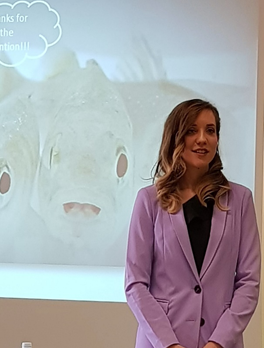
Michela Massimo presenting her PhD at the University of Udine

ParaFishControl article "CK11, a Teleost Chemokine with a Potent Antimicrobial Activity"

CK11, a Teleost Chemokine with a Potent Antimicrobial Activity. The Jounal of Immunology. 10.4049/jimmunol.1800568

CK11 is a rainbow trout (Oncorhynchus mykiss) CC chemokine phylogenetically related to both mammalian CCL27 and CCL28 chemokines, strongly transcribed in skin and gills in homeostasis, for which an immune role had not been reported to date. In the current study, we have demonstrated that CK11 is not chemotactic for unstimulated leukocyte populations from central immune organs or mucosal tissues but instead exerts a potent antimicrobial activity against a wide range of rainbow trout pathogens. Our results show that CK11 strongly inhibits the growth of different rainbow trout Gram-positive and Gram-negative bacteria, namely Lactococcus garvieaeAeromonas salmonicida subsp. salmonicida, and Yersinia ruckeriand a parasitic ciliate Ichthyophthirius multifiliis. Similarly to mammalian chemokines and antimicrobial peptides, CK11 exerted its antimicrobial activity, rapidly inducing membrane permeability in the target pathogens. Further transcriptional studies confirmed the regulation of CK11 transcription in response to exposure to some of these pathogens in specific conditions. Altogether, our studies related to phylogenetic relations, tissue distribution, and biological activity point to CK11 as a potential common ancestor of mammalian CCL27 and CCL28. To our knowledge, this study constitutes the first report of a fish chemokine with antimicrobial activity, thus establishing a novel role for teleost chemokines in antimicrobial immunity that supports an evolutionary relationship between chemokines and antimicrobial peptides.

Check out all ParaFishControl publications here